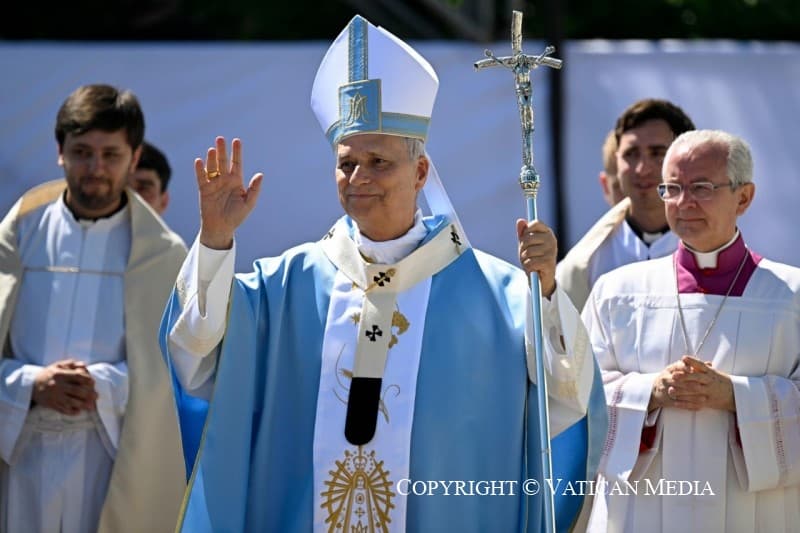
The Holy Father visited the homeland of his predecessor, Francis, stepping off the Aerolíneas Argentinas flight with a clear agenda directed at both government authorities and the opposition.
His visit focused heavily on those marginalized by the current economic model: individuals with disabilities, those deprived of their liberty, young people, and popular workers.
His first encounter with the political class and the diplomatic corps took place at the Palacio Libertad, Centro Cultural Domingo Faustino Sarmiento on Sunday, November 8 (formerly known as Centro Cultural Kirchner - CCK).
Among the guests were national government authorities, including Vice President Victoria Villarruel, former President Mauricio Macri, and the Head of Government of the City of Buenos Aires, Jorge Macri. The opposition was represented by deputies and senators from the Unión por la Patria bloc, such as Jorge "Coqui" Capitanich, Cecilia Moreau, and Germán Martínez, among others. Governors including Axel Kicillof, Ricardo Quintela, Gildo Insfrán, Sergio Ziliotto, Martín Llaryora, Maximiliano Pullaro, and Osvaldo Jaldo were also present.
During this opening gathering, Pope Leo XIV delivered remarks that would set the tone for all subsequent visits.
One of the most prominent themes was work and the ability to make a living from it, emphasizing that labor is the fundamental basis for human fulfillment and contribution to the nation's development. In this regard, he highlighted families facing uncertainty when searching for employment, as well as retirees who contributed to the country's growth but currently struggle to cover their basic needs. In this context, Pope Leo XIV stated that
The economy must be at the service of the person, not the person at the service of the economy.
In line with this, the Holy Father urged society to pay attention to young people—who represent future generations—and stressed the responsibility of leaders to provide opportunities for them to build their life projects. Among the conditions necessary to foster a future in Argentina, he highlighted:
Strengthening in a special way education, vocational training, universities, and research.
He voiced strong support for public education, noting that the country has expanded instruction to increasingly broad sectors of society, allowing generations to cultivate their talents and serve national development.
Furthermore, he emphasized the recognition of human dignity from birth, extending this to individuals suffering from illnesses and disabilities.
On Monday, November 9, his schedule began at 9:15 a.m. with a visit to the staff and residents of the Pequeño Cottolengo Don Orione de Claypole. After listening to Marta and Norma, two residents of the Cottolengo, the Successor of Peter delivered an address.
He described the institution as a "city of charity" where:
The values of dignity, integration, and fraternal friendship that distinguish places like this have much to say to our societies, which are often driven solely by the pursuit of economic success or the cult of physical appearance.
Leo XIV placed great emphasis on individuals with disabilities, empowering their advocacy and calling for empathy, solidarity, and service to others.
May Argentina be capable of great works of charity, such as we see here, where the love of Christ triumphs over individualism and exclusion.
Following Holy Mass at the Monument to the Spaniards, he attended the Meeting with the World of Work at the Pontifical Catholic University of Argentina (UCA) at 4:10 p.m., continuing the focus on labor previously outlined.
This gathering brought together workers, business leaders, trade unionists, grassroots social movements, faculty, and other members of the UCA academic community.
Opening his address, he highlighted the ecological crisis and the irresponsible use of earth's resources in relation to labor, pointing to the need for integral ecology as formulated by Pope Francis:
According to which labor contributes to the responsible stewardship of creation, in which technical development must harmonize with respect for the rhythms of nature and the limits of diverse ecosystems.
Drawing on these principles, the Pope reminded listeners of the Social Doctrine of the Church, particularly the dignity of the human person. Echoing his words at the Palacio de la Libertad, the Holy Father reiterated:
The human being is the author, the center, and the end of all economic and social life; therefore, the economy must be at the service of the person, and not the person at the service of the economy.
The Pontiff sought to underline the necessity of a balance between economic principles, the perspectives of employers, and the needs of workers and their families.
He placed the blame for unemployment on those responsible for creating jobs rather than on the jobless themselves, stating that depriving someone of work wounds their dignity and excludes them from society.
He linked dignity to the common good, noting that labor enables individuals to take part in human development.
The common good requires overcoming sterile individualism and corporate utilitarianism, promoting a culture of encounter where economic growth translates into true integral human development.
Addressing social movements, the popular economy, and informal workers—such as cardboard collectors, peasant farmers, and artisans—he recalled the words of Pope Francis:
They do not passively await state assistance; they organize from below to build community solutions. Through their demand for social inclusion, they advocate for the three 'T's: land, lodging, and labor (tierra, techo y trabajo), which Pope Francis has frequently highlighted as demands of social justice.
He also spoke directly to business leaders, reminding them to be guided by the social function of property and capital:
You are called to subvert this technocratic logic through ethical investment that prioritizes environmental sustainability and the dignity of labor, recognizing that financial success must be measured in terms of the common good.
Finally, he reminded trade unions of their essential role as intermediaries between workers and corporations, describing them as an "indispensable institution when they defend the voiceless and resist the commodification of labor."
On Tuesday the 10th, the Pope traveled to Córdoba to celebrate Holy Mass on the esplanade of the Military Aviation School, followed by an encounter with bishops, priests, deacons, consecrated religious, seminarians, and pastoral workers at the Cathedral of Our Lady of the Assumption. During the gathering, he invoked Pope Francis with his famous phrase, "Hagan lío" (Make a mess) (Encounter with Argentine Youth, Rio de Janeiro, July 25, 2013).
Dream of a Church that continues to make a mess, as your compatriot Francis asked of you!
Following his visit to Córdoba, he attended the youth vigil at the Monument to the Spaniards that evening. His message to the youth emphasized mercy toward one's neighbor and a spirit of service:
Share your bread with the hungry, open your doors to the homeless, and visit the sick and those whom no one else visits.
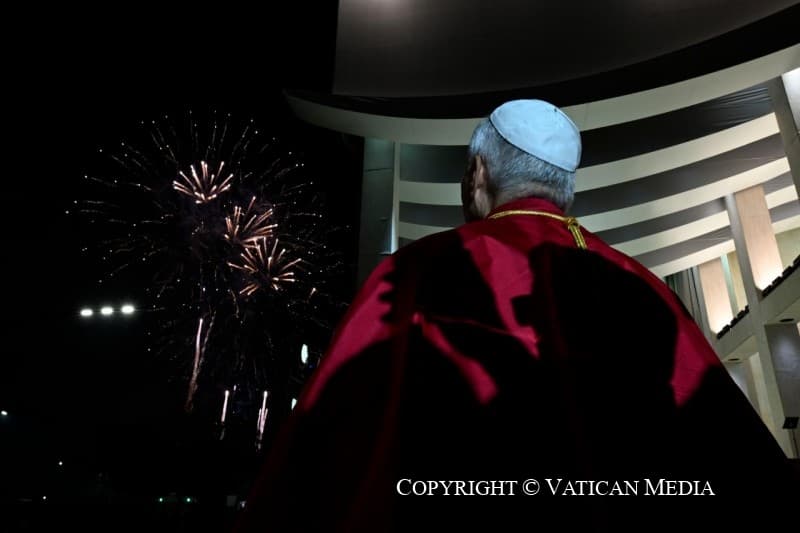
On his final day in Argentina, he visited the Federal Penitentiary Complex in Buenos Aires, where he reflected on new opportunities offered by God and the chance for incarcerated individuals to embrace them:
Even in the midst of the deepest evil, pain, and failure you may have experienced or caused, your current situation is also a unique moment to restart your lives.
He urged prison staff, professionals, and volunteers to maintain their vocation of help and service, while also addressing authorities and Argentine society:
We are part of the same human family; let us foster what contributes to the good of all, let us specially accompany our children and youth, educating them in authentic values, caring for them, and protecting them so they do not fall into the destructive networks of crime.
Following his visit to the penitentiary complex, he traveled to the Basilica of Luján to celebrate his final Mass, where thousands of the faithful awaited to bid him farewell.
He praised Argentina for its people, their generosity, and their profound human quality:
During these days I have been able to witness the richness of Argentina, not only in its geography but above all in its people—in every encounter, in the squares and streets, in their creativity, spontaneity, and the overflowing life present at every turn.
He proposed a four-step itinerary for the country: reconciliation, illumination through the Word of God, communion, and being sent forth on a mission. He championed evangelization, echoing the motto of his visit: "Go and announce."
In his closing remarks at the end of Holy Mass, he stated:
Dear brothers and sisters: I thank God for all that I have experienced during my visit to this country, the birthplace of our beloved Pope Francis. I thank everyone who worked to make this possible: civil and religious authorities, organizers, collaborators, and volunteers, as well as the countless individuals, families, and communities who participated in each gathering or followed them through the media. Thank you, Argentina, for welcoming me with open arms!
The messages of Pope Leo XIV center on empathy, solidarity, and social justice. They challenge society to rethink the economy and labor by including the marginalized and protecting the environment. His overarching goal during this joyful visit was to set a clear objective: to integrate and show mercy toward those excluded by society. He called upon political leadership and authorities to invest in human development through labor, education, and the restoration of dignity to the people.