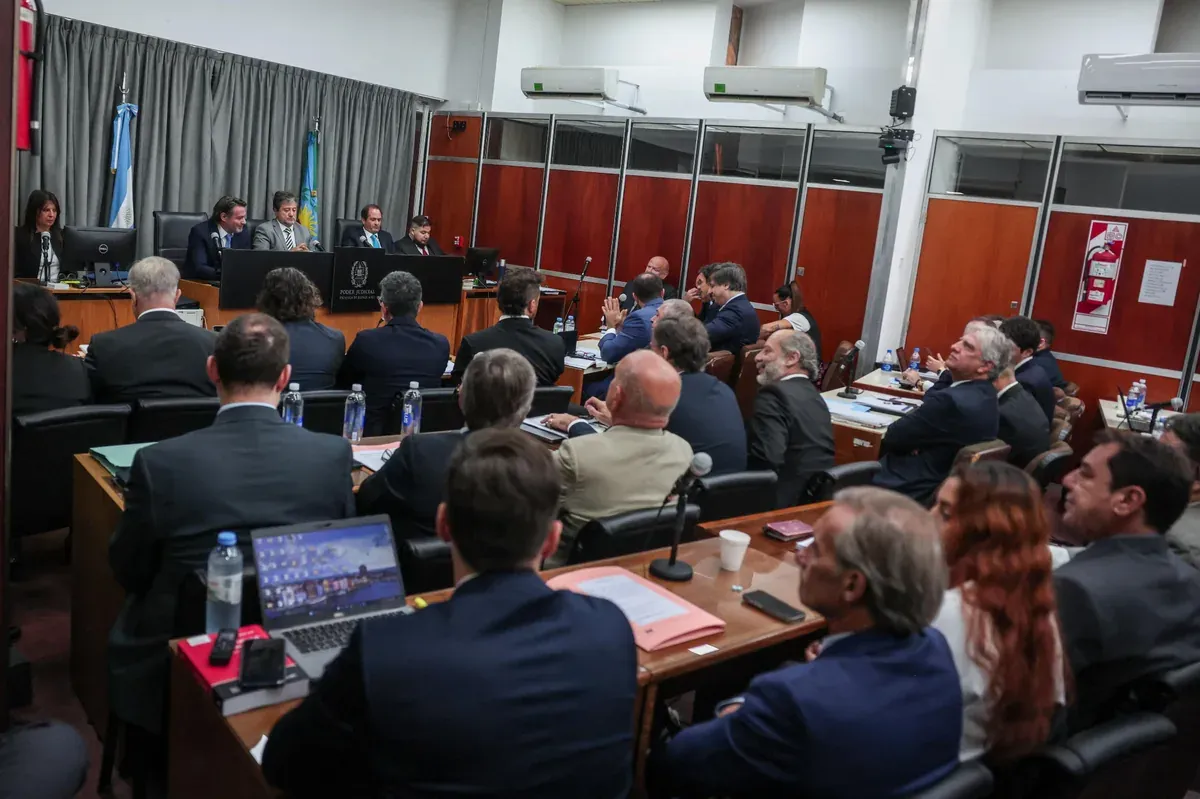
The trial over the death of Diego Armando Maradona entered one of its decisive stages this Thursday. After 45 hearings and more than 70 witness testimonies, the prosecution presented its final arguments before the 7th Criminal Oral Court of San Isidro and defined the penalties it seeks for the accused professionals.
During their presentation, prosecutors Patricio Ferrari and Cosme Iribarren reconstructed the former footballer's final weeks of life and argued that the evidence gathered during the trial establishes that his death could have been prevented.
Ferrari was unequivocal in describing the home care setup: according to the prosecution, Maradona was subjected to disorganized care lacking necessary controls. The prosecution even described the system as a "time bomb."
Penalties sought by the Prosecution
The highest request was for neurosurgeon Leopoldo Luque, for whom the prosecution sought 12 years in prison and 10 years of disqualification from practicing medicine.
For Nancy Forlini, the home care coordinator at Swiss Medical, prosecutors demanded 10 years in prison and 10 years of professional disqualification.
Meanwhile, for psychiatrist Agustina Cosachov, they requested 8 years in prison and 10 years of disqualification.
Requests for the other accused were:
Carlos Díaz, psychologist: 5 years in prison and professional disqualification.
Mariano Perroni, nursing coordinator: 4 years in prison.
Ricardo Almirón, nurse: 4 years in prison.
For these last three, the prosecution modified the legal classification, arguing their conduct would fit negligent homicide, while for Luque, Forlini, and Cosachov, it maintained the charge of simple homicide with eventual intent.
"A time bomb": the accusation against the medical team
One of the main axes of the arguments was how Maradona's home hospitalization was organized after his surgery. The prosecution argued that the medical team was aware of the multiple risk factors the former footballer presented and that, despite this, a monitoring scheme adequate to his condition was not implemented.
During his presentation, Ferrari questioned the organization of care and suggested that the house where Maradona stayed should have functioned practically as a permanent medical unit.
The prosecutor argued that he was a patient with a complex clinical situation and that those in charge of his care "increased the risks" that already existed.
Maradona's health status
Cosme Iribarren dedicated part of his presentation to describing the medical conditions Maradona presented in his final days.
The prosecutor argued that the former footballer was not simply a patient recovering from a surgical intervention, but that he had a history of renal, neurological, hepatic, and cardiac issues, in addition to problems related to alcohol consumption.
For the prosecution, these conditions required permanent medical monitoring and a comprehensive evaluation of his state. Iribarren argued that the evidence incorporated during the trial allowed determining that Maradona underwent progressive deterioration and that his death would not have been a completely unexpected episode.
The accusation insisted that it was a process that could have been detected and addressed in advance.
The final hours and the role of the nurses
One of the points questioned by the prosecutors was the monitoring Maradona received during the final hours of November 25, 2020.
Ferrari placed special emphasis on the actions of nurse Ricardo Almirón. According to the accusation, during the shift change, it was reported that Maradona was in good condition and had consumed fluids.
However, the prosecutor questioned that information and argued that Almirón had not entered the room to personally check the patient's condition. The prosecution used this episode to argue that there were concrete failures in controls and communication among those responsible for the former footballer's care.
A death that, according to the Prosecution, was avoidable
The central hypothesis of the accusation is that Maradona did not die as a consequence of a sudden and unpredictable cardiac episode, but after a process of deterioration that did not receive the necessary medical response.
Iribarren argued during his statement that it was an "avoidable death" and questioned the fact that the patient remained in a residence without the resources of a hospital stay. The prosecution argued that the medical evidence allowed reconstructing a picture of multiple organ failure and prolonged agony.
For the prosecutors, criminal responsibility does not derive simply from the final outcome, but from a series of decisions and omissions made in the days prior to the death.
Prosecution drops charges against Pedro Di Spagna
One of the main news items from the arguments was the prosecution's decision to drop the charges against clinical doctor Pedro Di Spagna.
After analyzing the evidence produced during the trial, the prosecutors concluded that there were not enough elements to sustain his criminal responsibility. Ferrari explained that Di Spagna had intervened as a consulting physician and did not have decision-making power over Maradona's comprehensive treatment. For this reason, the prosecution requested his acquittal.
The decision marks an important difference regarding the other six accused, for whom the prosecutors did consider there are elements to sustain different degrees of responsibility.
What did the accused say?
The defendants rejected the accusations during the process and defended their respective actions.
Leopoldo Luque denied being responsible for Maradona's comprehensive clinical care during the home hospitalization and argued that his intervention was mainly linked to post-operative follow-up. Luque's defense also questioned the prosecution's hypothesis and argued that Maradona could have suffered an unpredictable cardiac decompensation.
For her part, Agustina Cosachov denied having occupied the role of clinical doctor and defended her intervention as a psychiatrist. Nancy Forlini also explained during the trial what her functions were within the home care scheme and rejected having the level of responsibility attributed to her by the prosecution.
These positions will be developed in greater depth during the defense arguments.
The trial reaches its final stage
The trial is now at a decisive instance. After the prosecution's arguments, the private prosecutors and the defenses must present their own conclusions before the court.
The defenses of the accused are scheduled to argue between October 20 and 22. Then, the defendants will have the opportunity to deliver their final statements before the court moves toward deliberation.
The 7th Criminal Oral Court of San Isidro must determine if the evidence gathered during the trial allows proving the criminal responsibilities raised by the parties.
Maradona died on November 25, 2020, at the age of 60, while recovering from surgery for a subdural hematoma. Now, almost six years after his death, the judicial process enters its definitive phase.